You'll be able to tell on the phone, though. Usually within the first few minutes of a consult call, once you know what to listen for.
A good-fit IFS therapist can tell you exactly how they trained and is honest about what the work can't promise. Most of all, they go slowly with the parts of you that work hardest to keep you safe. That last piece matters a lot if self-sabotage is part of why you're searching. You don't need your story sorted out before you call. Most people don't have it sorted.
TL;DR Quick Answers
IFS Therapy
IFS therapy, short for Internal Family Systems, is a talk therapy that sees your mind as a group of parts, each one trying to protect you in its own way. Underneath them sits a calmer center called Self. Richard Schwartz developed the model in the 1980s.
How it works: You get curious about a part, like the inner critic or the one that sabotages good things, and ask what it's afraid would happen if it stopped.
What the evidence says: Pilot studies show promise for depression and PTSD. The research base is still young, and a good therapist will tell you so.
What matters most: Pace. Skilled IFS asks protective parts for permission and never rushes you toward old pain.
Who provides it: Clinicians trained through the IFS Institute, from Level 1 up to IFS Certified. Ask which level before you book.
What Are Signs An IFS Therapist Is A Good Fit?
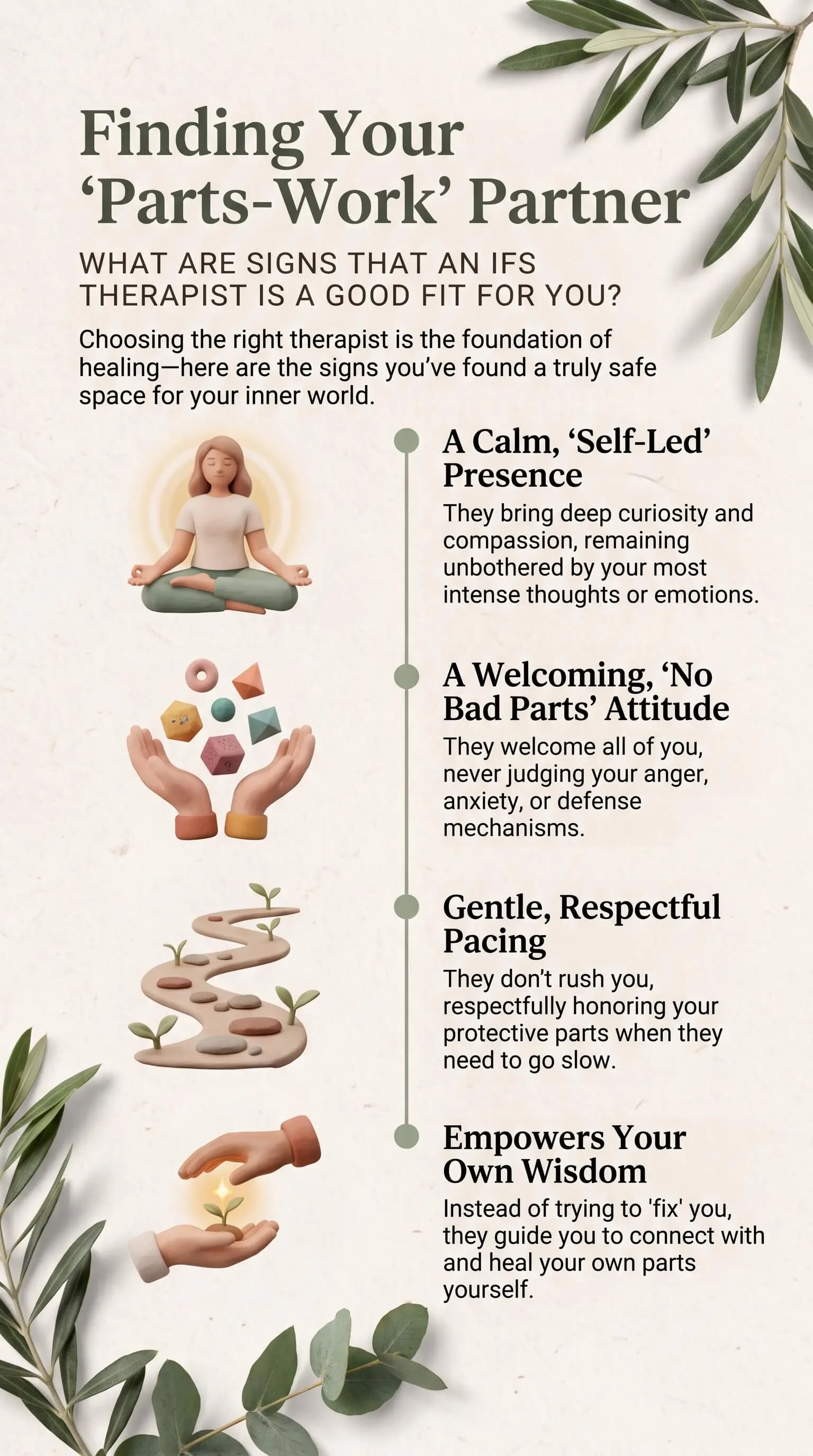
A good-fit IFS therapist names their exact training and license, talks honestly about what IFS can't promise, and treats every part of you with curiosity. They let your protective parts set the pace, steady things before going deep, and refer out when you need more. You should feel a little steadier by the third session.
What Are Red Flags In An IFS Therapist?
Watch for vagueness about training, pressure to process painful material in the first session, hints about memories you don't recall, calling parts bad or toxic, and promised timelines. One of these deserves a follow-up question. Several mean keep looking.
What Should I Ask An IFS Therapist First?
Start with "What IFS training have you completed, and are you certified?" Then ask what happens if a part of you doesn't want to do the work. You're hoping for a specific answer to the first and a patient one to the second.
Can IFS Therapy Help If I Keep Sabotaging Myself?
Often, yes. IFS sees self-sabotage as a protective part that learned its job for a reason. A good IFS therapist helps you understand what that part is guarding, so it can ease off without being forced.
Top Takeaways
A Directory Listing Isn't A Credential. Ask for the exact level, whether that's 1, 2, 3, or Certified, and check it against a state license.
Pacing Is The Clearest Signal You'll Get. Watch whether the therapist asks your protective parts for permission or plows ahead.
No Part Of You Is The Villain. Anyone who calls a part bad or toxic isn't practicing IFS the way it was designed.
Online IFS Is A Serious Option. The therapeutic relationship predicts outcomes about as well over video, so a strong therapist on the far side of your state can beat a so-so one down the street.
Give It About Three Sessions. Early nerves are normal. Still feeling unseen after that is information worth acting on.
What IFS Therapy Is, In Plain Language
IFS stands for Internal Family Systems. The idea underneath it is one you probably already know from the inside. You aren't one voice. You're several, and they don't always agree.
Richard Schwartz developed the Internal Family Systems model in the 1980s, coming at it from his background in family therapy. Some parts manage your day, some react fast when something hurts, and some carry old pain while the others work hard to keep quiet. Underneath all of them sits a steadier center that IFS calls Self.
That way of seeing things changes how self-sabotage looks. The part that procrastinates, or picks a fight right before something good happens, usually has a job it has been doing for years. If that sounds familiar, the hidden saboteur within is the same pattern seen from another angle.
Why The Therapist Matters As Much As The Model
IFS asks protective parts to step aside so you can meet whatever they've been guarding. With a skilled therapist, that tends to feel like relief. Rushed, it can leave you more shaken than when you walked in.
The model came under hard scrutiny in October 2025, when Rachel Corbett's investigation for The Cut described clients who felt harmed after therapists pushed past their protectors too quickly . I read that reporting as an argument about pace more than a verdict on the model. Either way, the useful question shifts from whether IFS works to whether this particular therapist practices it carefully. That includes understanding how the therapist addresses key health issues, respects emotional boundaries, and adjusts the pace of treatment to each client's needs.
7 Green Flags To Look For In An IFS Therapist
1. They Tell You Exactly How They Trained
A good IFS therapist will name their level without hedging, whether that's Level 1, 2, 3, or IFS Certified, along with the license they hold in your state. "IFS" on a directory profile can mean a full training sequence or a single weekend workshop. You're allowed to ask which one.
2. They're Honest About What IFS Can't Do Yet
Research on IFS is growing and still young. A trustworthy therapist says so before you have to find out on your own. Listen for plain language and an absence of promises, because a guaranteed result is a sales pitch.
3. Every Part Gets Curiosity, Even The Inner Critic
A good therapist doesn't cast anyone in your system as the villain. Not the critic, and not the part that cancels plans an hour beforehand. They want to know what that part is afraid would happen if it stopped.
4. They Let Your Protectors Set The Pace
This one matters most. A skilled therapist checks in with protective parts before going anywhere deeper and treats hesitation as useful information rather than something to push through. If you want a feel for that slower rhythm, this walkthrough of parts work therapy shows what a careful session looks like from the client's chair.
5. They Make Things Steady Before Going Deep
Early sessions often cover unglamorous ground, like who you can lean on and what tends to knock you over. That groundwork carries extra weight when trauma is part of the picture, since self-sabotage and PTSD so often show up together. A good therapist treats it as part of the work.
6. They Know When To Bring In Someone Else
IFS is one tool among several. When EMDR or a higher level of care would serve you better, a good therapist says so without getting territorial about it.
7. You Feel A Little More Like Yourself
You can say no in the room. You can say "that doesn't fit," and the therapist gets curious instead of defensive. Somewhere around the third session, you might notice you're bracing less. Pay attention to that.
What IFS Training Levels Actually Mean For You
The IFS Institute offers three training levels, and certification sits on top of them as a separate step. Here's what each label tells you.
IFS Level 1 Trained: Finished the foundational program. It's a solid start, so ask how much of their week is IFS now.
IFS Level 2 or 3 Trained: Went on to one or more advanced programs, which usually means more experience with complicated protective systems.
IFS Certified: Logged at least 2 years and 200 hours of IFS practice after Level 1, plus 15 hours of consultation, 15 hours of continuing education, and an observed session. Someone actually watched them work.
Approved IFS Clinical Consultant: Certified, with 3 or more years of IFS practice after Level 1. Other IFS therapists go to these clinicians for consultation.
One catch worth knowing. The Institute's practitioner directory runs on self-reported credentials, so check your state licensing board too.
Red Flags That Mean Keep Looking
Any one of these deserves a follow-up question. Two or more, and I'd keep looking.
Gets vague or prickly about training when a clear answer would take ten seconds.
Pushes you toward painful material in the first session before anyone has checked in with your protectors.
Suggests memories you don't have or hints at what "must have" happened.
Calls any part of you toxic, broken, or bad.
Names a timeline, such as a set number of sessions until you're fixed.
Discourages medication or other care instead of working alongside it.
Questions To Ask On Your First Consult Call
Write these down before you dial. Nerves have a way of erasing them.
What IFS training have you completed, and are you certified? You want an answer that's specific and easy to check.
How much of your practice is IFS right now? Regular, current use counts for more than a training finished years ago.
What happens if a part of me doesn't want to do this? Listen for patience. "We'll work through the resistance" is a yellow flag.
How do you keep sessions from getting overwhelming? Good answers mention pacing and checking in with you as you go.
When would you refer me to someone else? Comfort with this question says a lot about a clinician.
What does the first month usually look like? Mostly getting to know you and your parts, and that's how it should be.

"Some of the most useful consult calls I get start with an apology. Someone tells me, a little sheepishly, that a part of them almost didn't dial. I tell them that part is welcome in the first session, and I mean it. When I ask a hesitant part what it's worried about instead of talking past it, the work usually gets safer. I've watched that happen with clients, and I've felt it from the other chair too."
Essential Resources
Seven places worth bookmarking. Each one lets you check something for yourself instead of taking a profile's word for it.
Search For A Trained IFS Therapist Near You
The official directory lets you filter by location, training level, certification, and online availability. Use it as a starting list, since every listing is self-reported.
Source: IFS Institute Practitioner Directory
See What "IFS Certified" Actually Requires
This page spells out the practice hours, consultation, and live observation behind the certification label. Read it before a consult call so you know what you're asking about.
Source: IFS Institute, Certification Eligibility Requirements
Borrow A Federal Checklist For Judging Fit
NIMH suggests asking a provider about their experience with your issue, how they usually treat it, how long it might take, and what it costs. Those questions pair well with the IFS-specific ones above.
Source: National Institute of Mental Health, Help for Mental Illnesses
Walk Into The Call A Little More Prepared
Five short tips on getting ready for a mental health conversation, from writing questions down to asking about other options if a suggestion doesn't sit right. Handy if your mind tends to go blank once someone picks up.
Source: NIMH, Tips for Talking With a Health Care Provider
Cross-Check A Psychologist's Credentials
The APA's locator searches licensed psychologists by state, specialty, insurance, and language. It's a quick way to widen a shortlist or confirm someone is who their profile says.
Source: American Psychological Association, Psychologist Locator
Find State-Licensed Care Beyond Talk Therapy
SAMHSA's confidential locator covers state-licensed mental health and substance use treatment across the U.S. Worth knowing about if you need more support than weekly sessions can offer.
Source: SAMHSA, FindTreatment.gov
Keep A Crisis Line Close While You Search
Looking for a therapist can stir up more than you expect. The 988 Lifeline is free and confidential, and you can call, text, or chat with someone at any hour.
Source: 988 Suicide & Crisis Lifeline
Supporting Statistics
Three numbers worth knowing before you pick, and what I notice in each one.
The Relationship Predicts Outcomes Across 295 Studies
Researchers pooled 295 independent studies covering more than 30,000 patients, published between 1978 and 2017.
The link between the therapeutic alliance and treatment outcome came out at r = .278 for face-to-face therapy.
Internet-based therapy landed almost exactly there too, at r = .275.
What I notice: this is the number I'd show anyone who feels silly trusting their gut on a consult call. How the relationship feels is one of the best-studied predictors of whether therapy helps, and it holds up over video.
Source: Flückiger et al., The Alliance in Adult Psychotherapy, Society for the Advancement of Psychotherapy
IFS Kept Pace With Standard Depression Treatment
Researchers randomly assigned 37 college women with depression to IFS or treatment as usual (CBT or interpersonal therapy), and both groups improved at a similar size and speed.
Four of the five therapists delivering IFS had less than a year of IFS experience.
What I notice: even fairly new IFS clinicians held their own here. The IFS Institute itself points to that inexperience as a likely reason these results looked more modest than other studies, which is exactly why I'd still ask how long someone has been practicing.
Source: IFS Institute, summary of Haddock et al. pilot study
Online IFS Held Up For People With Complex Needs
Ten adults living with both PTSD and substance use joined a 12-week online IFS program.
Each person attended 12 weekly groups and 6 individual counseling sessions.
Participants rated it 86% on acceptability and 92% on willingness to refer a friend.
70% were still enrolled at the 12-week mark.
What I notice: ten people is a small study, and I wouldn't lean on it too hard. It does suggest telehealth IFS can work even when someone's needs are complicated, which opens your search well past your own zip code.
Source: Frontiers in Psychiatry, Online Group-Based IFS Pilot (2025)
Research involving 295 studies and more than 30,000 patients shows that the relationship between therapist and client plays an important role in treatment outcomes, whether sessions take place in person or online. Early IFS studies also suggest promising results for depression and people with complex mental health needs, although more research is needed. These findings highlight the importance of choosing a qualified professional who understands your individual needs. Much like selecting a private school consultant to guide important educational decisions, finding the right IFS therapist involves considering their experience, approach, and ability to build trust.
Final Thoughts And Opinion
Most advice on picking a therapist ends at "find someone you click with." Fair enough, but IFS asks a bit more of you. You're asking protective parts to trust a stranger, and those parts deserve a vote.
Here's where I come down, including the bits that cut against the enthusiasm around IFS.
How A Therapist Handles Hesitation Tells You More Than Their Level. A Level 3 clinician who rushes your protectors is a worse fit than a Level 1 clinician who waits. Training gets someone in the door, and pacing is what makes you want to come back.
The 2025 Criticism Is A Reason To Vet Carefully. Most of the harm described came from going too fast. A careful IFS therapist already agrees with that critique, and you'll usually hear it in how they talk about pace.
Your Self-Sabotaging Part Gets A Say In The Interview. If something in you wants to cancel the consult, notice it before you obey it. The right therapist will want to meet that part.
Three Sessions Beat Three Weeks Of Research. Read the profiles, ask your questions, then let yourself start. Fit tends to show up in the room long before it shows up on a screen.
What you're looking for is a therapist who makes it slightly easier to stop arguing with yourself, and that bar sits well below perfect.
Frequently Asked Questions
Q: Is IFS Therapy Legitimate?
A: Yes, with honest limits.
IFS has pilot trials behind it for depression and PTSD, though its evidence base is younger and thinner than CBT's.
Rachel Corbett's October 2025 investigation for The Cut raised real concerns about clients destabilized by rushed work. A well-trained therapist who paces carefully addresses most of that risk.
Q: What's The Difference Between Level 1 Trained And IFS Certified?
A: Level 1 is the foundational training program. Certification comes later and requires at least 2 years and 200 hours of IFS practice after Level 1, 15 hours of consultation, 15 hours of continuing education, and an observed session. Both can be a good fit. Certification just means someone reviewed the work directly.
Q: How Do I Verify An IFS Therapist's Credentials?
A: Look them up in the IFS Institute directory for training level, then search your state licensing board for their license and any disciplinary history. The directory relies on what clinicians report about themselves, so the board check matters more.
Q: How Many Sessions Before I Know It's A Good Fit?
A: Around three. Parts that don't trust easily often need a few meetings before they relax. If you still feel rushed or unseen by then, you're allowed to switch, and trying more than one therapist is a normal part of the search.
Q: Can IFS Therapy Work Online?
A: Yes. The work is conversational and turned inward, so a screen gets in the way less than you'd think. Confirm the therapist is licensed in the state where you live.
Q: Is IFS Therapy Safe For Complex Trauma?
A: It can be, in skilled hands. Look for someone who stabilizes first, asks protectors for permission, and never pressures you toward memories. Ask them directly how they keep sessions from tipping into overwhelm.
Q: Does Insurance Cover IFS Therapy?
A: Often, when the therapist is in-network and bills it as standard psychotherapy. Many IFS specialists are private pay, so ask about superbills and check your plan's out-of-network mental health benefits.
Q: Can IFS Therapy Help With Self-Sabotage?
A: It fits self-sabotage unusually well. IFS treats the sabotaging behavior as a protective part doing an old job, which means you get curious about it instead of fighting it. Most people find that shift alone takes some of the shame out.
Find An IFS Therapist Who Fits You
You don't have to pick perfectly, just carefully. Bring these green flags to your next consult call and notice how your parts react while you listen. Unlike choosing professional services such as marketing agencies, where results and past performance often guide decisions, selecting an IFS therapist also requires paying close attention to emotional safety, trust, and how comfortable you feel discussing personal experiences.
If a part of you wanted to skip the call entirely, say so out loud. The therapist who leans in with curiosity at that moment is probably the one to book.