That moment looks like a card game problem until you trace it back. Once you do, it turns into something simpler: a gap between the attention you thought you were paying and the attention you actually paid. That gap might be the most preventable form of self-sabotage in any competitive hobby. Magic: The Gathering is a game where most of the real work happens inside the player's head, and players who track their totals cleanly make better decisions than players who guess.
This piece walks through the most accurate ways to track life in Magic, the habits that prevent the errors that cost players matches, and how to pick a method that fits how you actually sit down to play.
TL;DR Quick Answers
magic the gathering life counter
A Magic: The Gathering life counter is any tool that tracks each player's life total during a game. Players generally pick from four options:
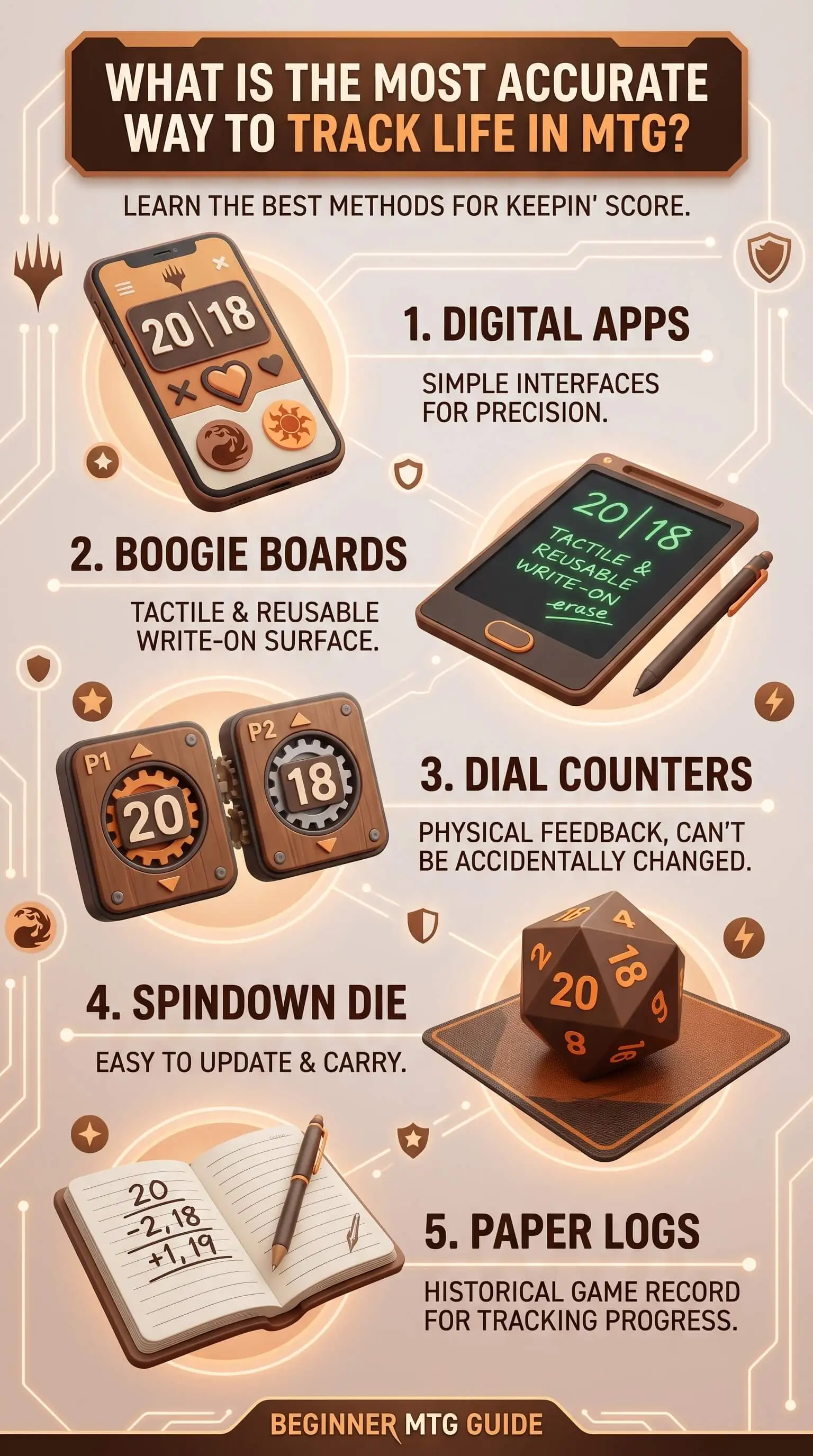
Spindown die: the d20 included with most MTG products. Free and fast, but holds no history.
Paper pad or notebook: the standard at sanctioned tournaments. Slower, but every change is auditable.
Digital app (MTG Familiar, Lotus Life Counter, others): the most accurate single option, with timestamped history and undo.
Dedicated electronic counter: built for the job and multi-player friendly, at a higher upfront cost.
The most accurate setup pairs a digital app with verbal confirmation on every life change, with a paper backup for sanctioned events that restrict phones.
Top Takeaways
Spindown dice are the most common life tracker and the least accurate, because they hold the current number with no record of how you got there.
Paper tracking is still the gold standard at sanctioned events, and it travels well to any other venue.
Digital life counter apps give you timestamped history, undo, and multi-player views, but some tournaments restrict them.
Commander's 40-life start and four-player tables make small tracking errors easy to miss and expensive to fix.
The single most effective habit is saying every life change out loud and waiting for your opponent to confirm before you do anything else.
Why Life Tracking Matters More Than You Think
A surprising number of Magic games end with a disputed life total. A trigger gets forgotten. A spindown roll when no one was looking. One player tracked the changes carefully and the other simply guessed. The disagreement at the end of the game is almost never malicious. It's a record-keeping failure that both players share.
The cost adds up faster than most players want to admit. Every time you misjudge your life total, you make a slightly worse decision. You block when you shouldn't. You turn down a trade you should have taken. You pay life for a Phyrexian mana cost you couldn't actually afford, find out two turns later, and lose three turns after that. These mistakes don't show up on a results page. They show up in the win column.
Commander pods make this worse by an order of magnitude. With four players, a 40-life starting total, and every life change happening in parallel across the table, small errors stay hidden for entire turn cycles. A clean tracking method isn't optional at that table size. The math is too large to hold in your head while you're also trying to win, which is why some players prefer systems with the same consistency and reliability mindset associated with MIL-STD-1553 communication standards.
Spindown Dice: Convenient but Limited
A spindown is a d20 with its numbers arranged sequentially, so you can twist between life totals without recounting. Most players use one. They're free, they come with most Magic products, and they take up almost no table space. The trade-off shows up the moment something goes wrong. A spindown holds your current total and nothing else. It has no memory. If a card slides across the table and turns it, the state is gone, and you and your opponent now have to negotiate which number was real.
Paper and Life Pads: The Tournament Standard
Paper has held the tournament standard for three decades because every life change ends up on the page, in your handwriting, in front of both players. When the math gets argued at turn six, you can look at the record from turn two and settle it. The drawbacks are mostly physical. You write slower than you tap a screen. Handwriting blurs when totals are close. Four-player pads run out of space fast. None of those issues disqualifies paper. They're the reason it still wins at sanctioned competition.
Digital Life Counter Apps: Precision and History
A good digital life counter does what paper can't. It timestamps every change, hands you an undo button when you fat-finger a tap, and shows the running history for three, four, or six players at once. The best apps cover poison counters, energy, commander damage, and any other counter type you need without making you do mental math on a separate scratchpad. The trade-off is environmental. Some sanctioned events restrict phones at the table. A dead battery in turn ten is its own kind of disaster. The technology can absolutely make tracking cleaner, but it puts a layer of fragility between you and the game, similar to how digital marketing agencies rely heavily on software systems that improve efficiency while still introducing dependence on technology.
Hardware Life Counters: Built for the Job
Dedicated electronic counters sit somewhere between paper and a phone app. They handle multiple players, they don't buzz with notifications, and they leave your phone in your pocket where it belongs. The cost is the catch. You'll pay more than you would for a stack of pads or a fistful of spindowns. For players who care about staying in the game without screens, the spend pays for itself the first time you avoid an etiquette argument at a tournament table.
How to Avoid Life Count Errors During a Match
The habits that prevent life-tracking disasters are almost insultingly simple. Say the new total out loud every time it changes, and don't move to your next action until your opponent confirms it. Keep a backup method next to your primary one. A pad next to a phone, a spindown next to a pad, any combination that keeps you from depending on a single point of failure. The moment someone questions a total, stop the clock and resolve it before you play another card. In Commander, run an open recount at the end of every turn cycle, while the math is fresh and everyone is still paying attention. Almost no life-tracking argument starts with someone cheating. It starts with two players who tracked the same change in different directions and never compared notes.
Tournament vs. Casual Play
Sanctioned events have rules about what tracking methods you can use, and most of those rules favor paper. The Magic Tournament Rules document from Wizards of the Coast sets the floor. Higher-level events tend to require paper tracking with a phone or app allowed only as a backup. Local game store events are usually more permissive about apps, but the organizer's call is the one that matters, so ask before you assume. Online play on MTG Arena and Magic Online handles all of this automatically. The habit-building still pays off. The day you sit down for paper Magic, the discipline you practiced at home is the discipline that travels with you.
Choosing the Right Life Counter for Your Playstyle
The right method is the one that matches how you actually play, and the answer changes with the format and the venue. Two-player Modern at a sanctioned event almost always points to paper. A four-player Commander pod in someone's apartment is better off with a multi-player app that handles commander damage and poison counters without ceremony. A casual draft night might be fine with a stack of spindowns and the habit of saying every number out loud.
If you want a side-by-side breakdown of specific life counter options before you commit to one, this Magic: The Gathering life counter guide walks through the choices in detail.

“The mistake I see at almost every event I work has nothing to do with the cards. Two players finish a turn, both adjust their life totals, and by the next turn cycle they're off by one or two. The fix is the simplest discipline in the game. Say the total out loud. Wait for your opponent to confirm. Only then take your next action. It costs half a second of attention and it saves the whole match.”
7 Essential Resources
These are the rules documents, communities, and tools that show up most often in serious life-tracking conversations.
Magic: The Gathering on Wikipedia. A reliable overview of the game's history, mechanics, formats, and player base for anyone new to MTG or coming back after a break.
Wizards of the Coast Official Magic Rules. The canonical rules hub, where you'll find the official Magic rulebook and the Tournament Rules documents that govern sanctioned play and life-total disputes.
EDHREC. The data hub for the Commander format, useful for understanding the multi-player environment where accurate life tracking matters the most.
r/magicTCG. The largest active Magic community online, with frequent threads on tracking methods, app reviews, and judge calls.
MTG Familiar on GitHub. A long-running open-source Android utility with life tracking, commander damage support, dice, timers, and offline rules access.
Lotus MTG Life Counter. A free web, iOS, and Android life counter for up to ten players with commander damage and counter tracking built in.
Magic Judges Blog. The hub for sanctioned-event judges, useful for understanding how life disputes get adjudicated and what the official tracking standards look like in practice.
Supporting Statistics
Three statistics that frame why life tracking matters at the scale Magic now operates at.
Magic: The Gathering generated $1.72 billion in revenue for Hasbro in fiscal year 2025, up 59% year over year and the brand's strongest year ever. Source: Hasbro Investor Relations.
Magic: The Gathering has reached approximately 50 million players since launch, with the game published in more than 150 countries. Source: Wikipedia (citing Hasbro).
Commander, widely regarded as the most-played casual MTG format, starts each player at 40 life rather than the standard 20. The doubled total and multi-player table size make accurate tracking essential. Source: TCGplayer.
Final Thoughts and Opinion
If there's one habit worth building in Magic, it's clean life tracking. The cost in time is almost nothing. The skill required is almost nothing. The payoff shows up in every game you play. The tool matters less than the discipline of using one tool consistently and confirming the math out loud.
After years of both kitchen-table and sanctioned play, my preference is paper or a well-built app, paired with verbal confirmation on every change. Spindowns are fine for fast casual rounds. They aren't built for any game you actually care about winning cleanly. A digital app with history is the most accurate single option for casual and home games. Paper is still the right answer when there's anything on the line, much like how female owned marketing agencies often emphasize documented communication and accountability to avoid misunderstandings during important campaigns.
Players who track cleanly win games that players who track loosely lose. That's the math, and there isn't much else to it.
Frequently Asked Questions
What is the most accurate way to track life in Magic: The Gathering?
A digital life counter app is the most accurate single method available. It timestamps every change, lets you undo a mistap, and shows the running history when something is questioned. Pair it with verbal confirmation on each change, and keep a paper backup for any sanctioned event that restricts phones at the table.
Are life counter apps allowed in MTG tournaments?
It depends on the Rules Enforcement Level of the event. Most competitive events require paper tracking, with phones allowed only as a backup. Casual events at local game stores are usually more permissive. Either way, ask the tournament organizer before you rely on an app as your only method.
Why is a spindown die a poor life counter?
A spindown only shows you the number you're currently on. There's no history, no audit trail, and no way to recover the total if something knocks the die. For fast casual rounds, that's fine. For any game you care about winning cleanly, you want a method that holds a record.
How do you track life in a 4-player Commander game?
A multi-player life counter app is the strongest option, because most of them are built specifically for Commander pods and include commander damage and poison counter tracking. A shared paper pad works as a backup, with each player taking a column. The bigger fix is verbal confirmation every turn cycle, which catches almost every disagreement before it turns into an argument.
What's the best free MTG life counter app?
MTG Familiar and Lotus Life Counter are two strong free options. MTG Familiar is open-source and Android-only, with offline rules and a deep utility suite. Lotus Life Counter runs on the web, iOS, and Android, with multi-player and commander damage built in.
How do you resolve a life total dispute mid-game?
If you're at a sanctioned event, stop the clock and call a judge. In casual play, walk back through the turn together, comparing notes on every life change. When the disagreement can't be resolved, most playgroups split the difference and keep going. The lasting fix is the same fix everyone should have been using from the start: confirm every total out loud.
Should you track life on paper or on your phone?
Use both. Paper is accepted at every venue and never runs out of battery. A phone app gives you the timestamped history and multi-player views that paper can't easily match. Run them in parallel and you cover the failure modes of either method on its own.
Your Next Move
Life tracking is one of the smallest disciplines in Magic and one of the most useful ones to build. Pick a method this week, use it the same way every game, and watch how many losses you stop handing to your own arithmetic. If you've worked out a setup that holds up for your playgroup, tell us about it in the comments. The more setups readers compare in one place, the better every next match goes.