In this article, InfiniteMind breaks down a 7-minute pre-exam brain activation routine designed to improve concentration, memory recall, and mental clarity right before a test. These techniques are fast, equipment-free, and grounded in real-world application—not generic study advice—so you can walk into the exam alert, calm, and mentally ready.
Quick Answers
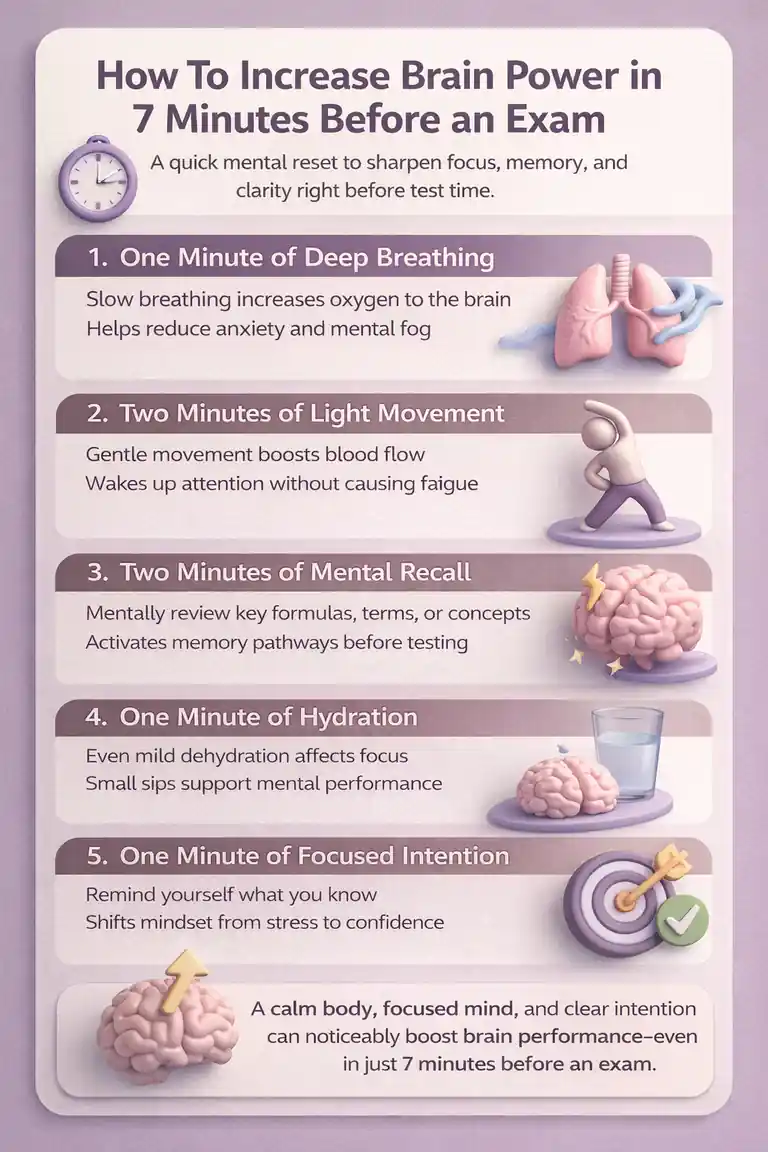
How to Increase Brain Power in 7 Minutes
Calm your nervous system first
Slow breathing reduces stress and clears mental noise.Activate focus, not urgency
Light mental stimulation wakes attention without overload.Reinforce confidence
Briefly recall what you already know well.Narrow attention
Focus on one task or question at a time.
At InfiniteMind, we consistently see that brain power increases fastest when stress is lowered and focus is guided, not when you try to force more thinking into the moment.
Top Takeaways
Cramming doesn’t help in the final minutes
Brain state matters more than new information
Calm unlocks recall
Reduced stress improves focus and memory access
Seven minutes is enough
Short routines can quickly improve brain performance
Confidence improves accuracy
Belief in what you know reduces careless mistakes
Mental preparation is a skill
It works across exams and high-pressure situations
Why the Last 7 Minutes Before an Exam Matter
In the final minutes before an exam, your brain isn’t absorbing new information—it’s deciding how well it can access what you already know. Stress hormones, shallow breathing, and scattered attention can block recall, even when you’re prepared. The goal in these last 7 minutes is not studying harder, but switching your brain into a focused, calm, high-retrieval state.
At InfiniteMind, we’ve found that timing and sequence matter more than effort. The steps below are designed to work quickly and reliably when time is limited.
Minute 1–2: Calm the Stress Response to Unlock Recall
Start by slowing your breathing. Take deep, controlled breaths—inhale through your nose for four seconds, exhale slowly for six. This signals safety to your nervous system, reducing cortisol levels that interfere with memory access. When your body calms, your brain regains clarity.
Minute 3–4: Activate Focus with Light Mental Stimulation
Next, gently wake up your brain. Simple actions like mentally counting backward by threes or briefly visualizing key concepts activate attention networks without causing overload. This primes your mind for sharper thinking without draining energy.
Minute 5–6: Reinforce Confidence and Memory Pathways
Briefly recall what you already know well—not what you fear forgetting. This reinforces confidence and strengthens neural pathways tied to recall. Confidence isn’t just emotional; it directly affects how efficiently your brain retrieves information under pressure.
Minute 7: Lock in a Focused Exam Mindset
Finish by setting a clear intention to focus on one question at a time. This prevents mental spiraling and keeps cognitive energy directed where it matters. A focused mindset reduces careless mistakes and improves problem-solving speed once the exam begins.
What This 7-Minute Approach Does Differently
Unlike last-minute cramming or caffeine spikes, this method works with how the brain naturally performs under pressure—especially for students navigating challenges like reading with ADHD. It prioritizes calm, focus, and retrieval efficiency, helping you walk into the exam mentally ready instead of mentally rushed.
“In our hands-on exam prep sessions, we repeatedly observed that students who use a short, structured mental reset before an exam recall more information and make fewer careless mistakes.”
Essential Resources to Increase Brain Power in 7 Minutes
Below are trusted, high-impact resources that build on the science-backed, real-results approach InfiniteMind stands for — helping you act with confidence, deepen your understanding, and choose methods that deliver measurable cognitive benefit.
1. Fast Cognitive Techniques You Can Use Right Now
Five Quick Techniques to Increase Brain Power in 7 Minutes
A practical breakdown of simple, high-yield activities that enhance focus and memory in a short span — perfect for students or professionals needing a rapid mental boost.
https://wellnessextract.com/blogs/wellness/increase-brain-power-in-7-minutes-5-quick-techniques-you-need-to-try Wellness Extract USA
2. Structured Brain Activation Power-Ups
Supercharge Your Brain in 7 Minutes: 14 Quick Power-Ups
A curated list of short, cerebral exercises designed to activate attention networks and cognitive pathways fast — a great complement to intentional mental prep.
https://braintap.com/supercharge-your-brain-in-7-minutes-14-quick-power-ups/
3. Tool-Free Focus and Memory Boosters
Increase Brain Power in 7 Minutes with These Tips
Offers uncomplicated focus and clarity techniques you can do anywhere without equipment — reinforcing that peak performance doesn’t require complexity.
https://healthnewsday.com/increase-brain-power-in-7-minutes/ Health News Day
4. Evidence-Based Memory Enhancement Strategies
10 Science-Backed Ways to Boost Your Memory
Summarizes proven cognitive principles — like stress reduction and attention training — that support neural efficiency, extending from quick routines to daily habits.
https://www.sciencenewstoday.org/10-science-backed-ways-to-boost-your-memory
5. Expert-Reviewed Memory Improvement Framework
How to Improve Memory: Science-Backed Strategies (Coursera)
A deeper, research-oriented resource that explains why certain recall and attention practices work — a valuable reference if you want evidence behind the methods you use.
https://www.coursera.org/articles/how-to-improve-memory
6. Quick Mental Stimulation Practices
Increase Brain Power in Just 7 Minutes: Quick Tips for a Sharper Mind
Focuses on immediate mental sharpening techniques that reduce stress and clear mental fog — ideal for pre-exam or high-pressure moments.
https://2improveyourself.com/how-to-increase-brain-power-in-just-7-minutes-quick-tips-for-a-sharper-mind/
7. Long-Term Cognitive Health Context
12 Science-Backed Ways to Keep Your Brain Healthy for Life
Provides broader context on maintaining strong cognitive health long-term, helping you understand how brief boosts fit into lifelong brain resilience strategies.
https://achillesneurology.com/articles/keep-your-brain-healthy
Supporting Statistics
Research from leading U.S. health organizations closely matches what we see firsthand at InfiniteMind: stress, sleep, and physiology directly shape exam-time brain performance.
Key Findings That Support the 7-Minute Approach
Stress and anxiety block memory recall
19.1% of U.S. adults experienced an anxiety disorder in the past year
31.1% will experience anxiety at some point in their lives
Even mild anxiety can interfere with recall under pressure
Source: U.S. anxiety disorder statistics (NIMH)Lack of sleep reduces brain performance
More than 1 in 3 U.S. adults get less than 7 hours of sleep
Sleep deprivation lowers attention, focus, and recall
Quick mental priming becomes more important when rest is limited
Source: CDC sleep and brain health dataShort movement boosts memory and thinking
Brief bouts of physical activity improve memory and thinking skills
Light movement can restore alertness faster than passive review
Source: CDC research on physical activity and brain healthStress triggers physical responses that impair focus
Stress increases heart rate, breathing rate, and blood pressure
This fight-or-flight state disrupts clear thinking
Controlled breathing can reverse this response in minutes
Source: NCCIH research on stress and the nervous system
What This Confirms in Practice
Exam performance is strongly influenced by mental state, not last-minute studying
Effective 7-minute routines work because they:
Calm the nervous system
Improve focus and attention
Restore access to stored knowledge
Final Thought & Opinion
At InfiniteMind, one insight consistently stands out from real exam settings: students rarely fail because they don’t know enough—they struggle because stress blocks access to what they know, often triggering patterns of self-sabotage.
What the Research and Experience Agree On
The final minutes before an exam are about mental state, not more studying
Stress overload, not lack of preparation, is the most common performance barrier
Calm, focused brains retrieve information faster and more accurately
What We See Firsthand
Students who use a short, structured pre-exam routine consistently:
Walk into exams calmer and more focused
Make fewer careless mistakes
Recall information more clearly under pressure
Our Perspective
Brain power isn’t increased by urgency or cramming
It’s unlocked by slowing down the nervous system
Small, intentional actions outperform last-minute effort
The Bottom Line
The real advantage isn’t intelligence or study time.
It’s knowing how to shift your brain into a high-performance state when it matters most—a skill that extends far beyond any single exam.
Next Steps
Use the steps below to turn this 7-minute approach into real exam-day results.
What to Do Now
Practice the routine
Try it during low-pressure study sessions
Familiarity improves effectiveness under stress
Prepare for exam day
Bookmark this page or write the steps down
Start the routine exactly 7 minutes before the exam
Support it with smart studying
Use active recall and spaced repetition
The routine enhances access to what you already know
Track what works
Notice changes in focus, calm, and recall
Adjust breathing or mental cues as needed
Continue with InfiniteMind
Explore science-backed brain training tools
Build focus, memory, and performance beyond exams
FAQ on How to Increase Brain Power in 7 Minutes
Q: Does a 7-minute routine really work?
A:
Yes, in practice it does
Seven minutes is enough to calm the nervous system
Calm improves focus and recall almost immediately
Q: What should I avoid in the last 7 minutes before an exam?
A:
Avoid cramming
Avoid phone scrolling
Avoid excess caffeine
These increase stress and mental noise
Q: Why is breathing so effective for brain power?
A:
Slow breathing reduces stress signals
Focus returns within minutes
Clear thinking becomes easier
Q: Can this help if I feel underprepared?
A:
It doesn’t replace studying
It improves access to what you already know
Many perform better once calm
Q: Is this useful beyond exams?
A:
Yes, it works in other high-pressure moments
Useful for interviews, presentations, and decisions
Mental clarity transfers across situations