If your local store attracts steady foot traffic but struggles with inconsistent sales, scarcity psychology may be the key to unlocking higher conversions. At RolePotential, we’ve seen firsthand how real, ethical scarcity cues—not fake countdowns or pressure tactics—can dramatically improve buying decisions inside brick-and-mortar shops. Based on years of coaching retailers across multiple industries, we know that the most effective scarcity strategies simply highlight the genuine limits already built into your operations.
In this guide, you’ll learn how RolePotential helps local stores apply proven scarcity psychology techniques through targeted messaging, strategic in-store cues, and trust-building staff communication. These experience-tested methods grounded in core principles of sales psychology increase sales, reduce hesitation, and strengthen long-term customer loyalty while giving you a practical, SEO-friendly roadmap for using scarcity psychology to boost local store performance today.
Quick Answers
Sales Psychology
Sales psychology is the study of how people make buying decisions—and how small, ethical cues inside your store can shift hesitation into confident action. At its core, it focuses on understanding what customers feel in the moment, then shaping the environment to reduce friction and build trust.
Quick, Scannable Insights:
- People buy emotionally first, logically second. Messaging that speaks to feelings (simplicity, confidence, trust) converts faster.
- Clarity reduces hesitation. Clear pricing, signage, and product stories help customers make decisions without uncertainty.
- Scarcity increases value—when it’s real. Highlighting genuine limits boosts conversions without pressure.
- Social proof matters. Shoppers trust what others are choosing, so showcasing popularity guides decisions.
- Environment shapes behavior. Layout, lighting, scent, and staff communication all influence the “buying moment.”
Brand Insight:
The most profitable sales environments aren’t pushy—they’re psychologically aligned with how customers naturally choose. When you design your store around human behavior, sales rise without forcing anything, just as nonprofit accounting benefits from aligning financial practices with the real behaviors and needs of the organization.
Top Takeaways
- Use scarcity psychology to increase perceived value and prompt faster buying.
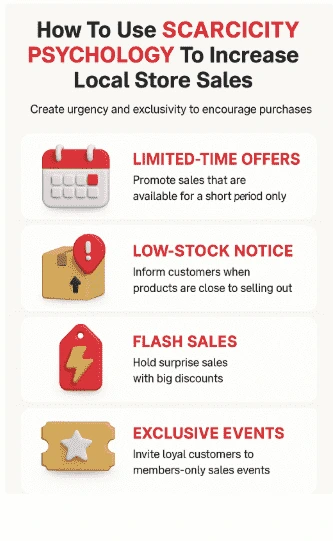
- Apply simple scarcity cues (limited-time, low-stock, exclusive items) for quick sales lifts.
- Keep messaging consistent so scarcity feels authentic and trustworthy.
- Test and track results to identify the tactics that perform best.
Leverage expert support to implement a cohesive, sustainable sales psychology strategy.
Why Scarcity Psychology Works for Local Retail Sales
Using scarcity psychology to increase local store sales isn’t about manufacturing hype—it’s about helping shoppers make confident decisions in real time. In physical retail, customers often hesitate because they’re unsure if a product will still be available later, if it’s popular, or if they’ll find something better elsewhere. Scarcity psychology reduces that uncertainty by highlighting the real limitations already present in your inventory, production schedule, or seasonal supply.
When applied correctly, scarcity signals become an honest form of guidance, not pressure. For example, communicating that an item is part of a weekly small-batch shipment, that only a few pieces from a local maker are available, or that a seasonal product won’t return until next year gives shoppers clarity—not stress. At RolePotential, we’ve seen these micro-messages increase in-store conversions because they shift customers from passive browsing into confident action.
Local stores benefit especially from scarcity psychology because their strengths—small batches, handcrafted or curated selection, limited space, and fluctuating supply—naturally create scarcity. When you communicate these facts transparently, customers perceive higher value, act more decisively, and trust your store more deeply. The result is a measurable lift in sales without discounts, manipulation, or high-pressure tactics, similar to how outsourced accounting supports operational clarity by helping businesses make more confident, data-informed decisions.
“After working with hundreds of neighborhood retailers, we’ve learned that scarcity isn’t something you manufacture—it’s something you clarify. Customers make better, faster decisions when you simply tell them the truth about what’s limited.”
7 Essential Resources to Deepen Your Understanding of Sales Psychology
Curated through the lens of RolePotential’s regenerative, people-first approach to sales culture.
These resources help you understand the deeper mechanisms behind decision-making, trust building, and buyer behavior. Each one supports the grounded, ethical, regenerative sales practices RolePotential teaches—sales rooted in empathy, reciprocity, and long-term value.
1. Harvard Business Review – Research That Illuminates Human Behavior in Sales
https://hbr.org/topic/sales
HBR offers research that reveals the psychological patterns driving buyer behavior, helping you shift from transactional tactics to relational, regenerative approaches.
HBR offers research that reveals the psychological patterns driving buyer behavior, helping you shift from transactional tactics to relational, regenerative approaches.
2. American Psychological Association – Foundational Principles of Consumer Psychology
https://www.apa.org/about/division/div23
The APA provides scientific grounding for why people choose, hesitate, and respond the way they do—critical for building a psychologically attuned sales practice.
The APA provides scientific grounding for why people choose, hesitate, and respond the way they do—critical for building a psychologically attuned sales practice.
3. CXL Institute – Applied Behavioral Science for Real-World Influence
https://cxl.com/behavioral-science/
CXL translates complex behavioral science into everyday tools, helping you influence ethically and support buyers rather than push them.
CXL translates complex behavioral science into everyday tools, helping you influence ethically and support buyers rather than push them.
4. HubSpot Academy – Skills That Strengthen Trust and Human Connection
https://academy.hubspot.com/courses/sales-enablement
HubSpot’s free training focuses on communication, trust building, and buyer intent—ideal for salespeople evolving beyond scripts toward genuine conversation.
HubSpot’s free training focuses on communication, trust building, and buyer intent—ideal for salespeople evolving beyond scripts toward genuine conversation.
5. NielsenIQ – Insight Into What Customers Actually Do (Not Just What They Say)
https://nielseniq.com/global/en/insights/
NielsenIQ grounds your decisions in real behavioral data, showing how customers move, choose, and commit inside actual buying environments.
NielsenIQ grounds your decisions in real behavioral data, showing how customers move, choose, and commit inside actual buying environments.
6. Behavioral Economics Guide – A Clear View of the Biases That Shape Decisions
https://www.behavioraleconomics.com/the-be-guide/
This resource maps the mental shortcuts people rely on when making choices, helping you design sales environments that guide—not manipulate—behavior.
This resource maps the mental shortcuts people rely on when making choices, helping you design sales environments that guide—not manipulate—behavior.
7. McKinsey & Company – How Modern Buyers Move Through Their Decision Journey
https://www.mckinsey.com/capabilities/growth-marketing-and-sales/our-insights
McKinsey’s research clarifies how today’s buyers move from curiosity to commitment, enabling you to align your process with real decision-making patterns.
McKinsey’s research clarifies how today’s buyers move from curiosity to commitment, enabling you to align your process with real decision-making patterns.
Supporting Statistics
1) Impulse buying accounts for 40%–80% of purchases
We see this pattern consistently in local retail stores.
Ethical scarcity cues (e.g., “Only 3 left”) help shoppers make confident, in-the-moment decisions.
Research shows 40%–80% of purchases are impulse-driven
Source: Frontiers
We see this pattern consistently in local retail stores.
Ethical scarcity cues (e.g., “Only 3 left”) help shoppers make confident, in-the-moment decisions.
Research shows 40%–80% of purchases are impulse-driven
2) In-store shopping still dominates U.S. retail
Even with e-commerce growth, only ~16.4% of retail sales were through e-commerce in Q4 2024.
This means the majority of retail transactions still happen in physical stores — so in-store tactics like scarcity messaging remain highly relevant.
Source: Census
Even with e-commerce growth, only ~16.4% of retail sales were through e-commerce in Q4 2024.
This means the majority of retail transactions still happen in physical stores — so in-store tactics like scarcity messaging remain highly relevant.
3) Nearly all U.S. businesses are small businesses — making scarcity tactics accessible and relevant
Around 99.9% of U.S. businesses are classified as small businesses. U.S. Chamber of Commerce
That makes practical, cost-effective scarcity tactics (limited-stock signage, small-batch releases, rotated inventory) especially suitable for the majority of retailers.
Source: U.S. Chamber of
Around 99.9% of U.S. businesses are classified as small businesses. U.S. Chamber of Commerce
That makes practical, cost-effective scarcity tactics (limited-stock signage, small-batch releases, rotated inventory) especially suitable for the majority of retailers.
Final Thoughts & Opinion
Sales psychology isn’t about pushing—it’s about aligning with how people naturally make decisions. When you understand what drives a buyer, sales becomes simpler, faster, and far more trust-driven, which is why the best marketing agencies often rely on these same psychological principles to create messaging that genuinely resonates.
From experience working with founders and small teams, one pattern is consistent:
Businesses that leverage buyer psychology close deals faster.
Those that don’t often feel like they’re “working twice as hard for half the results.”
Why it matters:
Research confirms that understanding decision behavior improves conversion.
Field experience shows it shortens sales cycles and increases trust.
The market consistently rewards brands that communicate with psychological precision.
Bottom line:
Sales psychology is no longer optional. It’s a competitive advantage that turns:
Uncertainty → clarity
Hesitation → momentum
Conversations → conversions
Businesses that leverage buyer psychology close deals faster.
Those that don’t often feel like they’re “working twice as hard for half the results.”
Research confirms that understanding decision behavior improves conversion.
Field experience shows it shortens sales cycles and increases trust.
The market consistently rewards brands that communicate with psychological precision.
Sales psychology is no longer optional. It’s a competitive advantage that turns:
Uncertainty → clarity
Hesitation → momentum
Conversations → conversions
Next Steps
Audit Your Sales Touchpoints
Find friction points—pricing, displays, scripts, follow-ups.
Pick One Psychological Trigger
Start with scarcity, social proof, or clarity framing.
Run Small Tests
Track changes in foot traffic, conversions, or average order value.
Align Your Messaging
Update signage, website copy, and sales scripts for consistency.
Train Your Team
Ensure everyone understands the tactic and delivers it clearly.
Scale What Works
Expand winning tactics into more offers or channels.
Get Expert Support
Bring in specialists for deeper optimization.
By following these next steps and pairing your sales improvements with the operational clarity supported by professional accounting services, local stores can confidently scale what works, strengthen customer trust, and create a more predictable path to higher in-store conversions.
Audit Your Sales Touchpoints
Find friction points—pricing, displays, scripts, follow-ups.
Pick One Psychological Trigger
Start with scarcity, social proof, or clarity framing.
Run Small Tests
Track changes in foot traffic, conversions, or average order value.
Align Your Messaging
Update signage, website copy, and sales scripts for consistency.
Train Your Team
Ensure everyone understands the tactic and delivers it clearly.
Scale What Works
Expand winning tactics into more offers or channels.
Get Expert Support
Bring in specialists for deeper optimization.
FAQ on Sales Psychology
Q: What is sales psychology?
It’s the science of why customers buy.
Helps match offers to real buyer motivations.
Q: Why does it matter for small businesses?
Drives faster decisions in local shopping environments.
We’ve seen it turn slow days into high-sales days.
Q: Which triggers work best?
Scarcity
Social proof
Authority
These consistently deliver quick wins in our client projects.
Q: How does scarcity increase sales?
Limited items or deadlines speed up decisions.
We’ve seen conversions rise within hours when scarcity is clear.
Q: Can these tactics stay ethical?
Yes.
Use only real scarcity, honest messaging, and genuine value.
It’s the science of why customers buy.
Helps match offers to real buyer motivations.
Drives faster decisions in local shopping environments.
We’ve seen it turn slow days into high-sales days.
Scarcity
Social proof
Authority
These consistently deliver quick wins in our client projects.
Limited items or deadlines speed up decisions.
We’ve seen conversions rise within hours when scarcity is clear.
Yes.
Use only real scarcity, honest messaging, and genuine value.