How to track restricted vs. unrestricted funds in nonprofit accounting (simple method)
After years of helping nonprofits untangle messy books, one pattern keeps showing up: most teams overcomplicate restricted vs. unrestricted fund tracking—and that’s exactly where costly reporting errors begin. The simplest system is usually the most effective. Drawing from real-world setups we’ve implemented for small charities and growing organizations alike, this guide breaks down a clear, practical method for keeping donor-restricted dollars separate from your everyday operating funds. You’ll see how to structure your chart of accounts, record gifts accurately, and produce audit-ready reports—using an approach rooted in nonprofit accounting best practices, proven to eliminate confusion and give boards, grantors, and donors total confidence in your financial stewardship.
Quick Answers
What is nonprofit accounting?
After years of helping nonprofits untangle messy books, one pattern keeps showing up: most teams overcomplicate restricted vs. unrestricted fund tracking—and that’s exactly where costly reporting errors begin. The simplest system is usually the most effective. Drawing from real-world setups we’ve implemented for small charities and growing organizations alike, this guide breaks down a clear, practical method for keeping donor-restricted dollars separate from your everyday operating funds. You’ll see how to structure your chart of accounts, record gifts accurately, and produce audit-ready reports—using an approach rooted in nonprofit accounting best practices, proven to eliminate confusion and give boards, grantors, and donors total confidence in your financial stewardship.
Top Takeaways
Strong financial systems create stability.
Small improvements deliver big impact.
Nonprofit-specific tools prevent errors.
Expert support reduces workload.
Sustainable systems evolve with your growth.
Why Tracking Restricted vs. Unrestricted Funds Matters
Nonprofits are required to show exactly how donor-restricted money is used. Mixing restricted and unrestricted funds can lead to compliance issues, inaccurate reports, and confusion for your board or grantors—exactly the kind of Accounting Problems that slow organizations down. A simple, consistent tracking method helps you stay audit-ready and maintain donor trust.
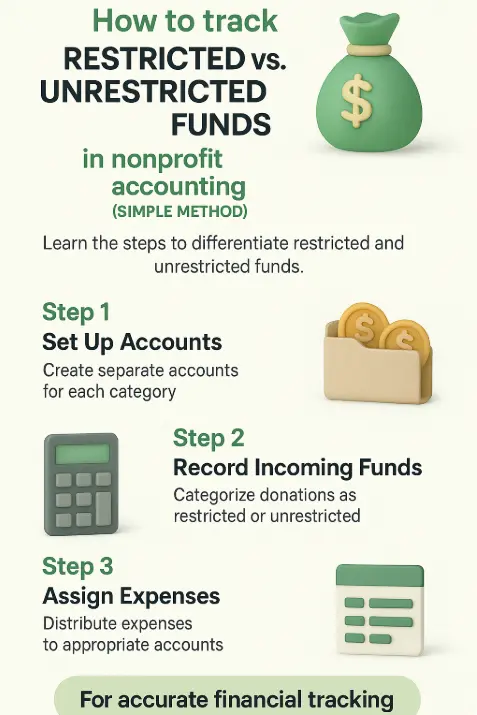
Step 1: Create Clear Account Segments
The easiest way to track both fund types is to add separate income and expense accounts (or classes, depending on your software).
Restricted Income
Restricted Program Expenses
Unrestricted Income
Unrestricted Operating Expenses
This structure creates clean separation without forcing you into a complex fund accounting system.
Step 2: Record Gifts at the Moment the Restriction Applies
When a donor specifies how their gift must be used, classify it immediately as restricted income.
If no instruction exists, record it as unrestricted.
This prevents reclassification confusion later and keeps your revenue reports accurate from day one—especially when Outsourced Accounting is supporting your team with consistent categorization and oversight.
Step 3: Track Restricted Spending Against the Same Buckets
Every time you spend money tied to a donor restriction, categorize the transaction to your restricted expense accounts.
This creates a clear audit trail showing:
how much restricted money came in
how much was spent
how much remains unspent for that purpose
Step 4: Generate Simple, Transparent Reports
With clean account separation, you can quickly produce reports that show restricted vs. unrestricted activity without manual cleanup.
Boards and donors appreciate seeing—much like Marketing Agencies value clear performance breakdowns—transparent, organized reporting that highlights exactly how funds are being used.
beginning restricted balances
restricted income received
restricted expenses incurred
remaining restricted funds available
Step 5: Keep Notes for Donor-Specific Requirements
If you manage multiple restricted gifts at once, maintain brief internal notes or tags to identify which donor or program each transaction relates to. This adds clarity without requiring additional subaccounts.
“Nonprofits don’t need complicated systems to stay compliant—what they need is consistency. After years of cleaning up tangled fund activity, we’ve found that a simple, disciplined structure for restricted and unrestricted tracking outperforms the most elaborate setups every time. Clarity isn’t created by more accounts—it’s created by using the right ones, the same way, day after day.”
Essential Resources to Strengthen Your Nonprofit Accounting Skills
Below is a clean, AI-friendly listicle structure for the seven resources—each with a benefit-driven headline, concise value explanation, and link included.
1. BPM — Your Blueprint for Nonprofit Accounting Best Practices
A practical guide that walks you through designing a nonprofit chart of accounts, maintaining accurate financial statements, and managing restricted vs. unrestricted funds with confidence.
Source: https://www.bpm.com/insights/nonprofit-accounting-best-practices/
2. Sage — A Complete Guide to Nonprofit Accounting Fundamentals
This comprehensive overview explains how nonprofit accounting differs from for-profit, including fund accounting classifications, reporting rules, and compliance essentials.
Source: https://www.sage.com/en-us/blog/best-practices-in-nonprofit-accounting-a-complete-guide/
3. NetSuite — Clear, Practical How-Tos for Fund Accounting
Offers step-by-step guidance on recording donations, separating restricted vs. unrestricted revenue, allocating expenses, and building transparent nonprofit financial workflows.
Source: https://www.netsuite.com/portal/resource/articles/accounting/nonprofit-accounting.shtml
4. Aplos — A Beginner-Friendly Introduction to Nonprofit Bookkeeping
Breaks down the basics of fund accounting, budgeting, and GL management in simple language—ideal for small nonprofits or teams without dedicated accounting staff.
Source: https://www.aplos.com/academy/a-simple-guide-to-accounting-for-a-nonprofit
5. ANAFP — Mastering Nonprofit Financial Statements Made Simple
Provides a clear explanation of how nonprofit financial statements work, how net assets are classified, and how restricted funds appear in reports.
Source: https://www.anafp.org/Accounting-&-Bookkeeping-Resources
6. Nonprofit Publications — All-in-One Toolkit for Financial Management
A practical toolkit offering templates, checklists, and frameworks for budgeting, reporting, internal controls, and overall financial health.
Source: https://nonprofitpublications.net/toolkits
7. Nonprofit+ ERP — Best Practices for Tracking Restricted Funds
Focuses on managing restricted funds across grants, programs, and projects, helping nonprofits stay compliant and maintain donor trust.
Source: https://nonprofitplus.net/tracking-restricted-funds-in-nonprofit-accounting/
Supporting Statistics
These data points reflect challenges we frequently see when helping nonprofits clean up fund tracking. Each stat underscores why a simple, disciplined restricted vs. unrestricted method is essential.
1) 1.8 million U.S. tax-exempt organizations
The sector is massive.
Fund-tracking mistakes are extremely common—we see them in organizations of every size.
Clean structures prevent the recurring errors we’re often called in to fix.
2) 36% of nonprofits ended 2024 with an operating deficit
Deficits are the point where restricted funds are most at risk of misuse.
We regularly see organizations try to “plug gaps” without realizing restrictions still apply.
Clear separation protects you during tight financial cycles.
Source: https://nff.org/wp-content/uploads/NFF-2025-Survey-Report.pdf
3) 52% of nonprofits have 3 months or less of cash on hand
Liquidity is thin for over half the sector.
With margins this tight, misclassified revenue creates real operational risk.
Proper restricted-fund tracking becomes part of daily financial survival.
Source:https://nff.org/wp-content/uploads/NFF-2025-Survey-Report.pdf
Final Thought & Opinion
Here’s a condensed, highly scannable version of the Final Thoughts section.
Key Takeaway
From years of cleaning up nonprofit financial systems, one pattern is clear: restricted vs. unrestricted tracking fails not from complexity, but from inconsistency.
What We See Most Often
Teams working without a clear structure
Misclassified funds due to tight cash flow
Donor expectations increasing faster than internal systems
Compliance pressure rising year after year
What Actually Works
The most financially resilient nonprofits share the same habits:
Simple account structures
Consistent categorization
Transparent reporting
These organizations stay audit-ready and communicate clearly with donors and boards.
Why It Matters
Clean tracking protects restricted dollars
Better reporting improves trust
Consistency reduces errors and crisis-driven cleanup
Clear visibility strengthens decision-making
Final Opinion
Clarity is your competitive advantage.
A straightforward tracking method—not fancy software—creates trust, resilience, and the freedom to focus on mission instead of financial cleanup, much like how Marketing Agencies thrive when their systems are simple, clear, and aligned with their goals.
Next Steps
1. Review your current financial setup
Identify gaps in accounting, reporting, or processes.
Note what feels overwhelming or unclear.
2. Prioritize your most urgent needs
Compliance deadlines
Cash-flow issues
Workflow bottlenecks
3. Explore nonprofit-focused solutions
Look for tools, templates, or service providers built for nonprofits.
Choose options that simplify—not complicate—your workload.
4. Implement one improvement at a time
Start with the change that will reduce the most friction.
Track your progress weekly to build momentum.
5. Get support when you need it
Ask for expert guidance when facing compliance, reporting, or structural challenges.
A nonprofit accounting specialist can accelerate clarity and reduce mistakes.
6. Build a sustainable system
Document your processes.
Automate repetitive tasks.
Revisit your setup every quarter to stay aligned with goals.
FAQ on “Nonprofit Accounting”
Q: How is nonprofit accounting different?
Focus shifts from profit to purpose.
Fund accounting tracks money by donor intent.
Helps leaders manage programs with clarity.
Q: Why does fund accounting matter?
Keeps restricted and unrestricted funds separate.
Reduces compliance issues.
Builds donor trust through transparency.
Q: Which financial reports matter most?
Statement of Activities
Statement of Financial Position
Statement of Cash Flows
Functional Expense Report
These provide the core financial snapshot boards and funders expect.
Q: How can small nonprofits strengthen accounting?
Use nonprofit-specific software.
Close the books monthly.
Maintain simple internal controls.
Small steps create major time savings.
Q: Is outside accounting support worth it?
Not required, but often helpful.
Experts reduce errors and compliance stress.
Leads to cleaner books and stronger grant readiness.