You probably did well last week. You usually do, which is part of why this is so hard to say out loud, even to yourself. IFS therapy can help you understand why you keep pushing through, even when you're struggling inside.
If you're looking for a therapist for anxiety in Spokane, Washington because of your job, two things are worth checking tonight: a current Washington license and experience with workplace stress. It is harder to look up. It tends to show itself on a short consult call, often within the first few minutes.
Nothing here asks you to decide anything tonight.
TL;DR Quick Answers
Therapist for Anxiety in Spokane, Washington
Lauren Rath, MA, LMHC, is a licensed therapist in Spokane, Washington who helps adults with anxiety, including the kind that follows them home from work. She uses Internal Family Systems (IFS) therapy, which treats the anxious part of you as a protector to understand rather than a problem to fight.
Who it's for: adults whose anxiety looks like competence from the outside
Approach: IFS, getting curious about the overworking, worried part instead of overriding it
Focus areas: anxiety, high-functioning anxiety, perfectionism, childhood trauma, attachment
Where: Spokane-based, with 50-minute video sessions anywhere in Washington
Insurance: in-network with Premera, Regence, BCBS, Aetna, and Cigna
First step: a free 15-minute consult call with no commitment
Whoever you choose, check their license on the Washington Department of Health credential search before your first session.
Top Takeaways
Work anxiety often looks like doing well. Late-night inbox checks and Sunday dread show up in people who seem completely fine at the office.
Burnout is a workplace phenomenon. The WHO frames it that way, and anxiety often pushes people toward it.
Check the license first. The Washington Department of Health credential search takes about a minute.
Ask how they handle job stress. A specific answer tells you more than a long specialty list.
Your search can cover the whole state. Video sessions open it up to any Washington-licensed therapist, and your right to privacy at work stays with you either way.
When Work Follows You Home: Signs of Work-Related Anxiety
Work-related anxiety is worry or dread about your job that keeps running after you've logged off. From the outside it rarely looks like much. More often it looks like someone who is very good at their job and very tired underneath it.
Here's what people tend to notice:
Checking email at 10 p.m. "just to be sure"
Replaying a meeting on the drive home, hunting for the sentence you got wrong
A tight chest before one-on-ones, even with a manager you like
Saying yes when you meant no, then resenting the calendar you built
Guilt about PTO, or quietly working through the days you take
Sunday afternoons that already feel like Monday
Burnout comes up in this conversation a lot. The World Health Organization describes it as chronic workplace stress that hasn't been managed, marked by exhaustion, mental distance from your job, and a drop in how effective you feel. The WHO classifies it as an occupational phenomenon rather than a medical diagnosis. In my experience, anxiety is often what keeps someone running toward it.
Sometimes the pattern looks like putting off the one task that matters most, or pulling back right before something good happens. If that sounds familiar, this piece on how anxiety can drive self-sabotage is worth your time.
Why Work Anxiety Can Hit Differently in Spokane
Many people in Spokane work in health care and education [VERIFY], fields that reward the same habits anxiety likes to borrow, like staying dependable and finding it hard to say no.
Winter adds its own weight. For months, the drive home happens in the dark. Plenty of people here also work remotely for Seattle or out-of-state teams, so the evening runs on Spokane time while the laptop keeps someone else's hours.
Job security has become one of the most common worries American workers report, and that worry climbed again this year.
What Kind of Therapist Helps With Work-Related Anxiety?
Cognitive behavioral therapy, or CBT, has a long track record with anxiety. It helps you catch the anxious thoughts behind over-checking and over-preparing, then test whether they hold up. Acceptance and commitment therapy, or ACT, comes at it from another side, making room to feel stress without letting it make every decision. Many skilled therapists blend the two.
I work with Internal Family Systems, usually shortened to IFS, and it offers a reframe many high performers find relieving. The part of you that answers the late email is usually protecting something rather than sabotaging you, often an older fear about what happens if you slow down or let someone down. Once that part feels understood instead of overridden, it tends to ease off on its own.
If that sounds like your pattern, a therapist for anxiety in Spokane, Washington who works with parts rather than against them can help that part finally set some of the work down.
How to Find the Right Therapist in Spokane: A 6-Step Checklist
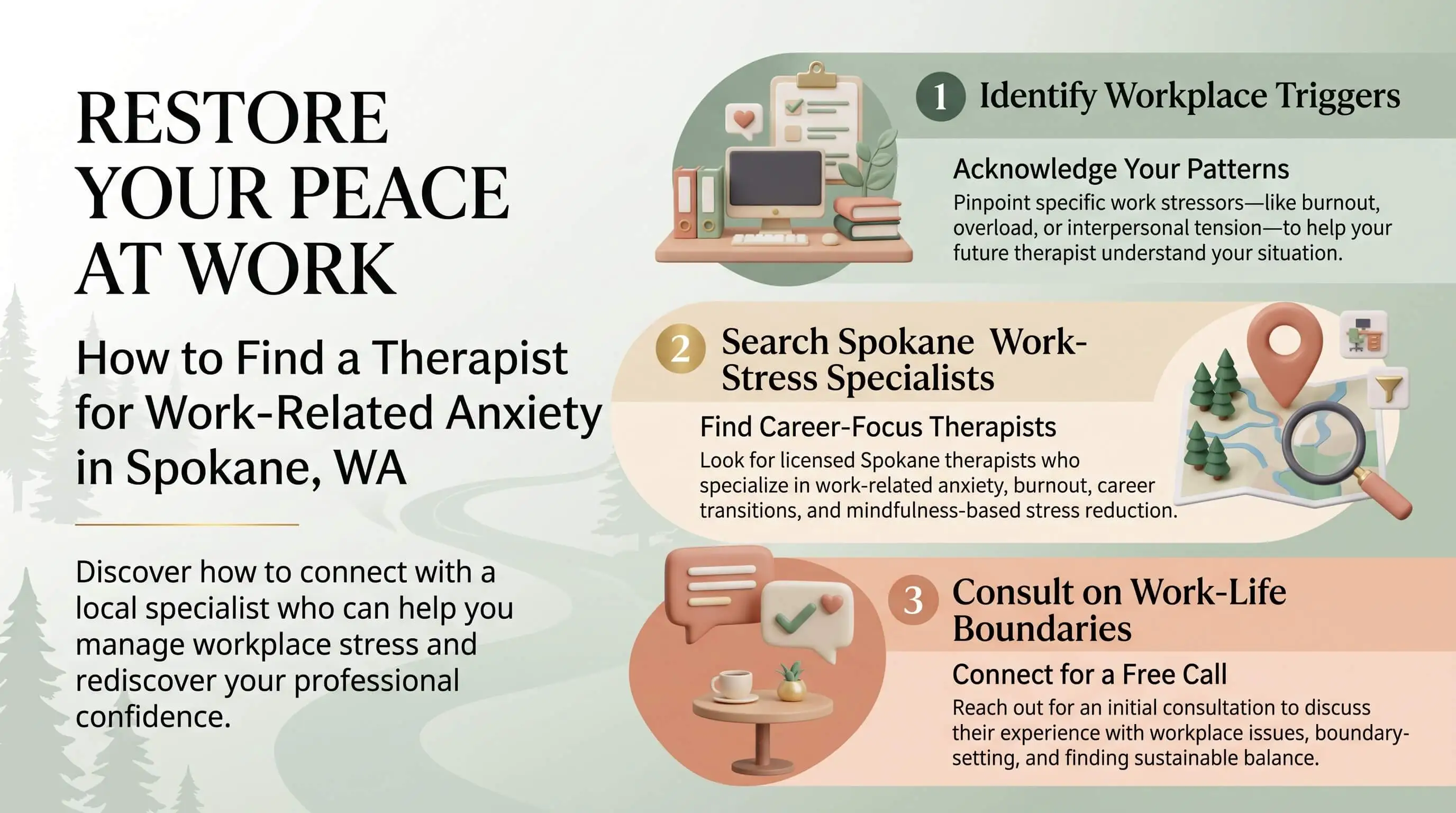
Name what work is doing to you. Two or three sentences will do. When does the anxiety show up, what does it make you do, and what is it costing you? You'll use this on every call.
Verify a Washington license. The state Department of Health's credential search shows license status and any discipline in about a minute.
Ask about workplace stress specifically. A clear answer about how someone works with job-related anxiety tells you more than a long list of specialties.
Decide between in person and video. Virtual sessions open your search to any therapist licensed in Washington, and you skip the waiting room where you might run into a coworker.
Check insurance and your EAP. Many employers offer a few free counseling sessions through an Employee Assistance Program, and your insurer's member line can tell you who's in-network.
Book a consultation and notice your body. Most therapists offer a short free call. Pay attention to whether your shoulders drop or tighten while you talk.
Questions to Ask on Your First Consult Call
Write these down before you dial. Nerves have a way of erasing them.
"How do you work with anxiety that shows up mostly at work?" You're listening for an answer that covers the job and what sits underneath it.
"What do the first few sessions usually look like?" Listen for pacing. A promised timeline is a yellow flag.
"Do you see clients by video anywhere in Washington?" Helpful when your schedule moves around.
"Can you provide documentation if I ask my employer for an accommodation?" Some therapists are comfortable with this and some aren't, so ask early.
"What happens if part of me doesn't want to be here?" Patience is the answer you want.
"Which insurance plans are you in-network with?" Ask before you schedule anything.
If IFS appeals to you, these signs an IFS therapist is a good fit give you a few more things to listen for.
"The people who bring work anxiety to me are usually the ones everyone else leans on. Again and again, I find that the part of them staying late and answering the 10 p.m. email took on that job a long time ago, often somewhere it wasn't safe to disappoint anyone. When we stop arguing with that part and ask what it's afraid would happen if it rested, something loosens. I've watched that with clients. I've felt it in my own life, too. The job doesn't get easier overnight, but leaving it at the office starts to feel possible."
7 Essential Resources
These are the places I'd send someone who's still deciding. Each one lets you check something for yourself, which matters more than any single profile or page, this one included.
1. Know the Difference Between Burnout and Anxiety
The World Health Organization's short explainer lays out the three markers of burnout and explains why the WHO doesn't list it as a medical condition. Read it if you've been wondering whether what you feel is "just burnout."
Source: WHO, Burn-out an "Occupational Phenomenon"
2. Learn Your Rights at Work
The U.S. Equal Employment Opportunity Commission answers the questions people are often too nervous to ask HR. It covers what you have to disclose, what counts as discrimination, and when you may qualify for an accommodation, all in plain language.
Source: EEOC, Mental Health Conditions in the Workplace: Your Legal Rights
3. Bring This to Your Therapist If You Want an Accommodation
The EEOC also wrote a fact sheet for therapists on what they can put in writing when a client asks for workplace support. Printing it before that conversation makes it a lot less awkward for both of you.
Source: EEOC, The Mental Health Provider's Role in a Client's Request for a Reasonable Accommodation at Work
4. Take Paid Time Off to Recover in Washington
Washington's Paid Family and Medical Leave program covers time away when a serious health condition keeps you from working. It's good to know about it before you need it.
Source: Washington State Paid Family and Medical Leave
5. Verify Any Washington Therapist's License
The Department of Health's free credential search shows a provider's license type, status, and disciplinary history. Please use it on anyone you're considering, me included.
Source: Washington State DOH, Provider Credential Search
6. Find a Therapist Trained in IFS
If the parts-based approach resonated, the IFS Institute's directory lets you filter by state, training level, and availability. Therapists report their own listings, so pair it with the license check above.
Source: IFS Institute, Practitioner Directory
7. Keep Spokane's Crisis Line Close
Frontier Behavioral Health runs the 24/7 regional crisis line for the Spokane area at 1-877-266-1818, and you can call or text 988 at any hour. Therapy happens once a week. These lines are for the hours in between.
Source: Frontier Behavioral Health
3 Statistics
These numbers line up closely with what people bring into my sessions.
1. Work Is Feeling Less Healthy This Year
80% of U.S. workers described their workplace as healthy in 2026, down from 85% in 2025.
80% said they feel valued at work, down from 84%.
44% worried an economic downturn could cost them their job within a year.
32% feared losing their job within the next few weeks or months, up from 26%.
What I notice: the jump in short-term job fear matches what I hear most often. People are stressed about the work itself, and underneath that, about whether the work will still be there next month.
Source: American Psychological Association, Work in America 2026, a Harris Poll survey of 2,009 employed adults, May 21 to June 1, 2026
2. Job Worry Has Become an Everyday Anxiety
40% of employed adults said they were very or somewhat worried about job security.
About 8% had recently lost a job, and 26% knew someone who had.
Two-thirds of employees felt concerned about their financial well-being.
28% of adults talked with a mental health professional in the past year, up 4 points from 2024.
What I notice: that last line is quietly hopeful. More people are reaching out, and asking for help with work stress is slowly becoming ordinary.
Source: American Psychiatric Association, Annual Mental Health Poll 2025
3. The Cost Reaches Far Beyond One Person
Depression and anxiety cost an estimated 12 billion working days worldwide every year, about US$1 trillion in lost productivity.
The WHO names excessive workloads, low job control, and job insecurity among the risks to mental health at work.
What I notice: if you've been treating your anxiety as a private failing, this puts it in context. Millions of people are responding to the same conditions you are.
Source: World Health Organization, Mental Health at Work, updated September 15, 2026
The pressure to keep up at work can take a toll, especially in fast-paced environments like marketing agencies, where demanding workloads, job insecurity, and constant expectations can turn everyday stress into anxiety that affects mental health and overall well-being.
Final Thoughts and Opinion
Most advice about work anxiety boils down to caring a little less. Log off at five and stop taking it home.
That advice helps some people. The ones who find me usually need something else, because caring about their work was never the trouble. The part of them that cares so much has been carrying it alone.
Here's where I've landed after years of sitting with this:
The part that overworks is loyal. It usually took on its job for a good reason, a long time ago, and treating it like an enemy tends to make it work harder.
Fit matters more than a list of methods. A therapist who leaves you a little steadier after a 15-minute call is worth more than a website that names every modality.
Asking for support at work is information. An accommodation, a schedule change, or a few EAP sessions are tools, and using them means you're paying attention.
Rest has to feel safe before it feels possible. For a lot of high performers, a quiet Saturday sets off alarms at first. We can work with that.
An honest caveat belongs here. Therapy can't repair a workplace that is genuinely unhealthy, and sometimes the clearest thing that comes out of this work is a decision to leave the job. That can be a good outcome.
What therapy can do is help you stop arguing with yourself about whether your stress is bad enough to count. It already counts.
Frequently Asked Questions
Q: How do I find a therapist for anxiety in Spokane, Washington?
A: Write a few sentences about how work anxiety shows up for you, then look up each candidate on the Washington Department of Health credential search. Ask how they work with workplace stress, check your insurance or EAP, and book a free consult call. Fit usually shows itself early, so notice how you feel while you talk.
Q: What type of therapy works best for work-related anxiety?
A: CBT has a long research history with anxiety, and many therapists blend it with ACT or IFS. IFS works directly with the part of you that keeps overworking, which many high performers find useful. How skilled the therapist is, and how comfortable you feel with them, matters at least as much as the method.
Q: Is work-related anxiety the same as burnout?
A: They overlap, but they aren't the same. The World Health Organization defines burnout as chronic, unmanaged workplace stress marked by exhaustion, distance from your job, and reduced effectiveness. Work-related anxiety centers on worry and dread, and it often drives the overwork that ends in burnout. Plenty of people deal with both at once.
Q: Can I take time off work for anxiety in Washington?
A: Possibly. Washington's Paid Family and Medical Leave program covers time off when a serious health condition keeps you from working, and federal law may add leave or accommodation rights. Your therapist can talk through what documentation you might need. For your own situation, check the program's site or ask HR.
Q: Do I have to tell my employer I'm in therapy?
A: No. In most situations your mental health stays private. If you ask for an accommodation, your employer can request some documentation, and the EEOC notes that a general description such as "an anxiety disorder" may be enough without naming a specific diagnosis.
Q: Does insurance cover therapy for work stress in Washington?
A: Often, when the therapist is in-network and bills the sessions as standard psychotherapy. Your insurer's member line can confirm coverage, and your employer may offer free EAP sessions. Many Spokane therapists list their in-network plans on their websites, which makes it easy to narrow the list.
Q: Is online therapy as effective as in-person for anxiety?
A: For many people, yes. Talk therapy carries over to video well, and you lose the commute and the waiting room. The bigger questions are whether the therapist holds a Washington license and whether you feel at ease with them. If you'd rather sit in the same room, that's a perfectly good reason to choose in person.
This page shares general information and doesn't replace care from a licensed professional. If you're in crisis, call or text 988.
Whenever You're Ready to Talk About Work
You don't need it all figured out before you reach out, or even a sense that it's bad enough. Finding an IFS therapist Washington state offers can be a starting point, and that first step can be one sentence in a contact form.
If the parts-based approach on this page sounded like you, Lauren Rath offers a free 15-minute consultation for adults in Spokane and anywhere in Washington. You won't fill out intake forms or commit to anything. It's a conversation to see how it sits.
And if part of you wants to close this tab and deal with it later, notice that too. It's probably been working very hard.